
Quick Answer
The best modern farmhouse floor is a wide plank, 5 to 9 inches, in a light-to-mid neutral wood tone with a matte finish. White oak hardwood sets the benchmark. Wood-look LVP with a 20-mil wear layer carries the same look through kitchens, basements, and homes with pets. Tile takes the bathrooms, and carpet takes the bedrooms.
Key Notes
- Plank width carries the style. Planks of 5 to 9 inches read farmhouse. Strip flooring under 3 inches reads traditional.
- Matte is the sheen to ask for. NWFA ranks it the least reflective of 4 sheen levels, and lower sheen hides small scratches better.
- White oak rates 1,360 Janka against 1,290 for red oak, and its neutral-to-tan undertone suits a white and black palette.
- The LVP we install runs 7 to 9 inches wide with a 20 or 22 mil wear layer over an SPC core, the tier that lasts 20 to 30 years.
- Wide planks need a flat subfloor. Most floating and glue-down floors call for flatness within 3/16 inch over 10 feet.
- Hold indoor humidity at 30 to 50 percent year round, the NWFA range, or wide hardwood gaps in winter and cups in summer.
What This Guide Covers
What Defines a Modern Farmhouse Floor?
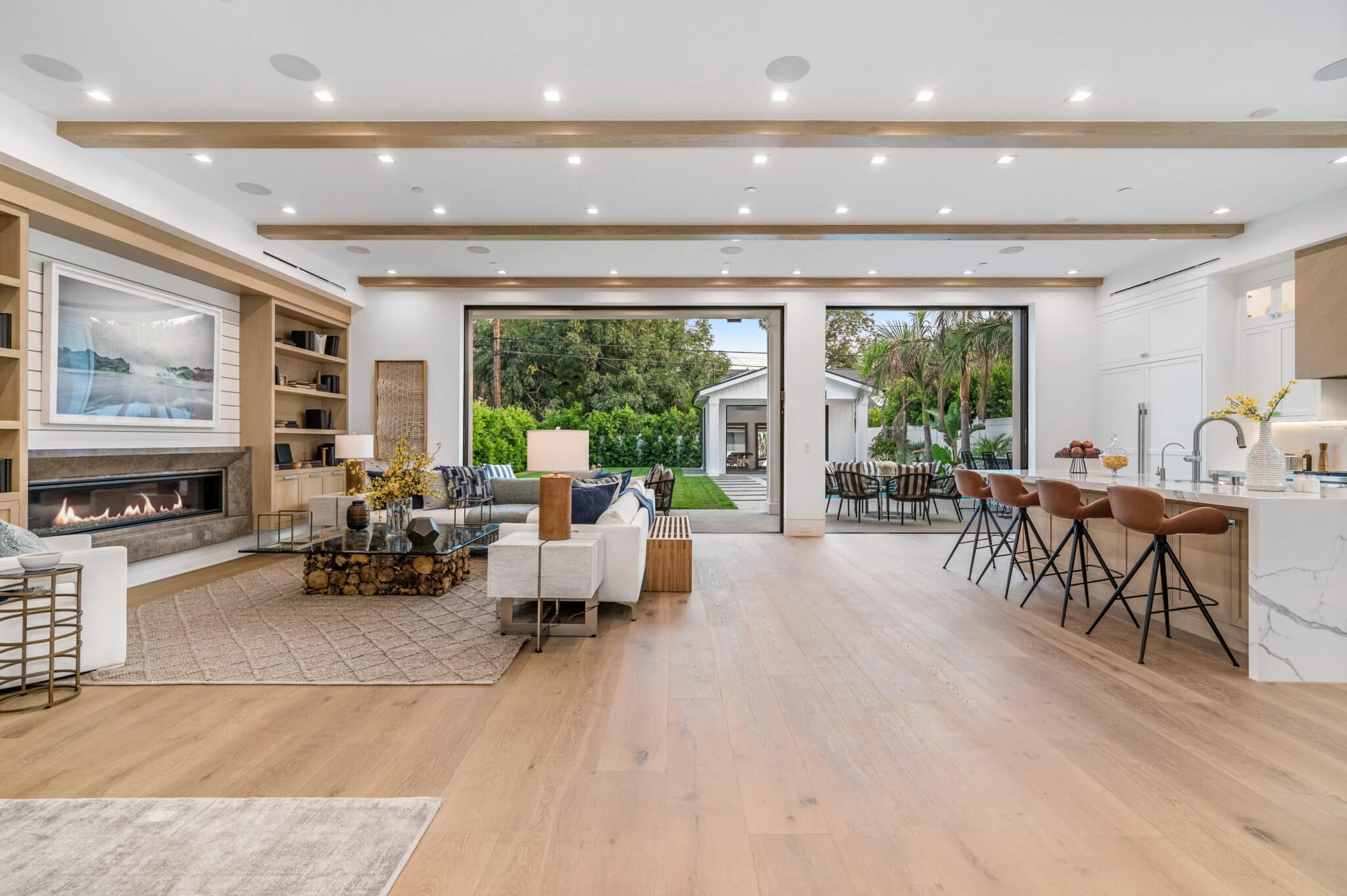
Modern farmhouse is a narrower style than most homeowners expect. It is not simply rustic, and it is not simply light. The look comes from four specs working together: plank width, surface sheen, color tone, and edge profile. Get those four right and almost any material we install can carry a modern farmhouse room. Get them wrong and even genuine white oak reads as builder-grade.
Most people shop by material first and style second, then wonder why a floor that checked every durability box still looks off against the shiplap and the black window frames. Style is a spec sheet too, and here is what it says.
Plank Width
5 to 9 in.
Wide reads farmhouse. Strips under 3 inches read traditional.
Finish Sheen
Matte
Least reflective of the 4 sheen levels. Gloss breaks the look.
Color Tone
Light to Mid
Neutral or slightly warm. Avoid orange and near-black.
Edge Profile
Fine Bevel
Defines each plank without deep grooves that trap grit.
Sheen deserves more attention than it gets. The National Wood Flooring Association's guide to finish sheen ranks gloss, semi-gloss, satin, and matte from most reflective to least, and notes that the less sheen a floor carries, the less small scratches show. That is the rare case where the look and the practical choice agree. The matte surface a modern farmhouse room wants is also the surface that hides daily wear best.
Color tone is where most projects go sideways. The palette leans on cool whites, soft grays, and black hardware, and a floor with strong orange or red undertones fights all three. That is why white oak became the default species for this look, and why red oak needs careful finishing to sit right in the room. If the wall color is still open, our guide to matching wall paint to your floor's undertone walks through which decision to make first.
How Each Material Handles the Modern Farmhouse Look
Go Flooring installs five materials: hardwood, luxury vinyl plank, laminate, tile, and carpet. Each one has a place in a modern farmhouse, though they are not interchangeable. The table splits hardwood into solid and engineered and pairs every option with the service life to plan around. For the reasoning behind each range, see our full flooring lifespan comparison by material.
Three of these carry the main living space well: hardwood, LVP, and laminate. Tile and carpet earn their place in specific rooms, which the room-by-room plan further down lays out.
White Oak Hardwood: The Benchmark Species

White oak became the modern farmhouse standard for a reason that has little to do with marketing. Its natural undertone is neutral to slightly tan, while red oak leans pink. In a room built on white millwork and black fixtures, that difference is visible from across the space. White oak also rates 1,360 on the Janka hardness scale against 1,290 for red oak, so it resists dents slightly better as well.
Wide planks are where the species shows its character. A 5 to 7 inch white oak board shows off the cathedral grain that gives the look its texture, and it puts fewer seams in a room. Fewer seams read calmer, which is much of the point of the style. Before settling on a width, it helps to know which way to run wide planks in a room, since direction changes how large the space reads.
Refinishability is what separates hardwood from everything else on this list. Solid hardwood can be sanded and refinished four to six times across its life, with each cycle removing roughly 1/32 inch of wood, so a floor worn by a decade of dogs and kids can be brought back instead of replaced. Go Flooring installs new floors and does not refinish or sand existing ones, so that later work goes to a refinishing specialist. The option exists with hardwood and not with LVP or laminate. Our page on solid and engineered hardwood options covers both constructions.
Reads Farmhouse
- White oak, 5 to 7 inch planks
- Matte or wire-brushed surface
- Neutral or lightly whitewashed tone
- Fine beveled edges, straight lay
Breaks The Look
- 2 1/4 inch strip flooring
- High-gloss sheen
- Orange-toned or near-black stain
- Deep V-grooves that collect grit
Where Wide Hardwood Runs Into Trouble
Wide planks and humidity swings are a difficult pairing. A 7 inch board moves across roughly three times the width of a 2 1/4 inch strip, so the same seasonal shrinkage produces visibly wider gaps in winter. The NWFA's guidance on winter humidity and road salt puts the target at 60 to 80 degrees Fahrenheit and 30 to 50 percent relative humidity, year round. With a wide-plank floor, holding that range is the maintenance cost of the look.
Hardwood also stays out of wet rooms. Bathrooms are off the table. A busy kitchen works only with disciplined spill habits, and a mudroom in a Michigan or Ohio winter, with salt and snowmelt coming through the door, wears through a wood finish faster than most homeowners expect. The same NWFA guidance notes that salt leaves an abrasive residue that scratches the surface.
If an installer quotes wide-plank flooring without checking your subfloor for flatness, get a second quote. Most floating and glue-down floors call for a subfloor flat within 3/16 inch over a 10 foot span, and a wider board telegraphs every dip below it. Skip that check and hollow spots, squeaks, and separated seams tend to show within the first year. We evaluate subfloor conditions during the free in-home consultation, before anything is ordered.
Wood-Look LVP: The Practical Modern Farmhouse Floor

Plenty of homeowners want the modern farmhouse look in a house where hardwood is a poor fit: slab-on-grade construction, a finished basement, three dogs, or a kitchen that gets used hard every night. Wood-look luxury vinyl plank handles all of that, and the current wide formats hold the style well.
The luxury vinyl plank we install runs 7 to 9 inches wide and 48 to 59 inches long, with a 20 or 22 mil wear layer over an SPC core. A 20-mil or thicker wear layer puts LVP in the 20 to 30 year range, where 6-mil and 8-mil budget tiers often show wear in 7 to 10 years. Our top-selling lines also carry FloorScore indoor air quality certification from RFCI, the standard for hard surface flooring emissions.
Texture is the spec that makes or breaks the look. Embossed-in-register texture, where the surface grain lines up with the printed grain beneath it, is the top tier and holds up under raking daylight from a farmhouse window wall. A well-embossed wood texture also reads convincingly. The thing to avoid is a smooth, flat print, which looks like a photograph of wood the moment sun crosses it. Bevel matters too. A painted, lacquered, or micro bevel defines each plank without the deep grooves that collect grit.
Watch the pattern repeat as well. Some products cycle through a small number of plank images, so the same knot shows up three times in one sightline. An open floor plan makes that repetition far easier to spot than a chopped-up traditional layout, so ask to see several planks laid side by side rather than a single sample.
One caution for sunrooms and big south-facing windows: vinyl surfaces tolerate roughly 140 degrees Fahrenheit, so window coverings matter on floors that take hours of direct afternoon sun.
Laminate: The Overlooked Modern Farmhouse Option
Laminate gets written off as the budget choice, and for thin, flat-printed product that reputation is earned. The laminate we install is a different product. It runs 7 1/2 inches wide with an embossed-in-register texture, an AC4 abrasion rating, and a 2mm attached pad under an 8mm plank. That width and texture put it squarely inside the modern farmhouse spec. For what the rating covers in daily use, see what an AC4 laminate rating means by room.
Water is the line to respect. Our laminate carries a 10-year waterproof warranty covering everyday spills and damp mopping, plus a lifetime pet stain warranty, which makes it a sound pick for living areas, bedrooms, offices, and busy family rooms. Full bathrooms and laundry rooms, where water can stand, still belong to tile or LVP. NALFA-certified laminate typically runs 15 to 25 years.
Where Tile and Carpet Fit
Tile for Bathrooms, Laundry, and the Mudroom
Ceramic and porcelain tile last 50 to 75+ years and do not really wear out in residential service. For the modern farmhouse look, a matte finish and tight grout joints in a color close to the tile keep it from reading commercial. Grout is the maintenance item: clean it yearly, reseal every 2 to 3 years, and plan on full replacement around 10 to 15 years. Grout work is a specialty service and not something Go Flooring provides.
Mudrooms are where tile earns its keep. The salt and grit that scratch a wood finish barely register on a fired tile surface, and a matte tile in a mid tone hides the tracked-in dirt between cleanings.
Carpet for Bedrooms and Upstairs
Modern farmhouse rooms are hard-surfaced, and they echo. Carpet in bedrooms, upstairs landings, and bonus rooms solves that without touching the main living areas. Every carpet we install is 100 percent solution-dyed polyester in a texture cut pile, and a cushion rated at 8 lb density and a 2.0 R-value is included on every carpet job.
Choose a neutral tone that sits close to the undertone of the hard floors next to it, and judge the carpet by pile density rather than face weight. A density of 3,100 and up holds up in a busy household. Our guide to how pile density and twist predict carpet wear explains the math. Carpet lifespans run 5 to 15 years depending on density and traffic.
A Room-by-Room Modern Farmhouse Plan

In our experience, most modern farmhouse projects end up with two or three materials rather than one. The trick is choosing them so the transitions look deliberate. Match the undertone and the plank width across the wood-look materials, and the eye reads one continuous floor even where the material changes.
Open plans raise the stakes, because a kitchen, dining area, and living room share one sightline. We cover the transition rules in detail in keeping floors consistent from room to room. The plan below is the starting point we would suggest for most homes.
We Bring The Showroom To You
See Wide-Plank Samples in Your Own Light
Floor tone shifts under every lighting condition, and a farmhouse window wall is unforgiving. A Go Flooring consultant brings samples to your home, evaluates your subfloor, and helps you match materials room to room. Call 877-356-6770 to book a free in-home consultation.
- ✓ Free in-home consultation with samples
- ✓ Subfloor conditions evaluated at the visit
- ✓ A+ BBB rated, licensed and insured
The Mistakes Our Crews See Most Often

Four patterns come up again and again on modern farmhouse projects, and all four are avoidable at the selection stage rather than after installation.
Chasing Gray
Heavy gray-washed floors were the shorthand for this style several years ago, and they date a room quickly. Neutral and lightly warm tones have held up far better, and they work with more future paint changes.
Matching the Floor to the Cabinets
A floor tone that sits too close to the cabinet or trim color flattens the room. Modern farmhouse interiors rely on contrast between white millwork, black hardware, and a floor that is clearly its own value.
Rushing Acclimation
Wide-plank hardwood needs to reach equilibrium with the home's normal living conditions before it goes down. Rushing that step is a common cause of the gapping that shows up the first winter after installation.
Buying LVP on the Sample Alone
A sample that looks convincing under store lighting can look flat in a room with a wall of south-facing windows. Ask for the wear layer in mils, the core type, the plank width, and the texture type before anything else. If a seller cannot give you those numbers, you cannot judge the floor's real service life.
How to Choose Your Modern Farmhouse Floor
The decision comes down to how the house is built and how hard the floor will be used. Work through these four cards in order, and the right material usually shows itself.
Choose wide-plank white oak if
You have a crawlspace or basement rather than a slab, you can hold indoor humidity between 30 and 50 percent, and you want a floor that can be refinished decades from now instead of replaced.
Choose engineered hardwood if
You want real wood on slab construction or in a humid Southeast climate. A 4mm or thicker veneer still refinishes once or twice and runs 25 to 50 years, with less seasonal movement than solid.
Choose wood-look LVP if
You have pets, young kids, a basement, or a hard-working kitchen, or you want one material running through the whole house. Hold the line at a 20-mil wear layer, an SPC core, and a plank 7 inches or wider.
Skip wide solid hardwood if
The house sits on a slab, indoor humidity swings far outside 30 to 50 percent, or the floor runs into a mudroom or bathroom. Those conditions work against a wide solid board, and a wood-look floor carries the same look without the risk.
Modern Farmhouse Flooring Questions
What flooring is best for a modern farmhouse?
A wide plank, 5 to 9 inches, in a light-to-mid neutral wood tone with a matte finish. White oak hardwood sets the benchmark. Wood-look LVP with a 20-mil wear layer carries the same look into kitchens, basements, and homes with pets.
What color flooring works best in a modern farmhouse?
Light to mid tones with a neutral or slightly warm undertone. The style relies on white millwork and black hardware, so orange-toned and near-black floors both fight the room. Heavy gray-washed floors were popular several years ago and now date a space.
Should modern farmhouse floors be wide plank?
Yes. Planks 5 to 9 inches wide are what make the style read correctly, because wider boards put fewer seams in a room. Strip flooring under 3 inches reads traditional regardless of the species or the finish.
Is LVP a good choice for a modern farmhouse?
Yes, at the right spec. Look for a 20-mil or thicker wear layer, an SPC core, a plank 7 inches or wider, and an embossed wood texture. A smooth, flat print looks like a photograph of wood once daylight crosses it.
What finish sheen looks best on farmhouse floors?
Matte. The National Wood Flooring Association ranks matte as the least reflective of four sheen levels and notes that lower sheen hides small scratches better. High gloss breaks the farmhouse look and shows every scuff.
Can laminate work in a modern farmhouse?
Yes. The laminate we install runs 7 1/2 inches wide with an embossed-in-register texture and an AC4 rating, which fits the style's plank and texture specs. It suits living areas and bedrooms, while tile or LVP still belongs in full bathrooms.
Is white oak or red oak better for a modern farmhouse?
White oak. Its undertone is neutral to slightly tan while red oak leans pink, which fights the white millwork and black hardware the style depends on. White oak also rates 1,360 on the Janka scale against 1,290 for red oak.
Can you mix flooring materials in a modern farmhouse?
Yes, and most projects end up with two or three. Hardwood or LVP runs the main living areas, tile handles bathrooms and the mudroom, and carpet goes in bedrooms. Keep undertone and plank width consistent so the transitions look deliberate.
Free In-Home Consultation
Plan Your Modern Farmhouse Floor, Room by Room
Tell us which rooms you are doing and how the house is built. A consultant brings samples in the widths and tones this guide covers and evaluates your subfloor during the visit. Call 877-356-6770 to schedule.
- ✓ Hardwood, LVP, laminate, tile, and carpet samples
- ✓ Room-by-room material plan
- ✓ A+ BBB rated

