
Quick Answer
Carpet vs hardwood stairs comes down to who uses the staircase. Carpet gives traction, absorbs the sound stairs amplify, and softens a fall. Hardwood and luxury vinyl plank look continuous with the floors above and below but are slick in socks. Density decides whether stair carpet lasts.
Key Notes
- Stairs concentrate traffic onto the nosing. The front 2 inches of each tread takes nearly every footfall, which is why stair surfaces fail at the edge long before the middle shows anything.
- Density is what makes stair carpet last. The carpets we install run a pile density of 3,600 to 4,480 with a twist of 5.75, well above the 3,100 that is normally treated as the threshold for heavy traffic.
- Most cushion warranties exclude stairs. The cushion included with every carpet we install carries a 20 year transferable abrasive wear warranty that covers stairs specifically.
- Stairs are a structural noise path. A staircase transmits impact sound into the framing of the whole house. Carpet over an 8 pound cushion with a 2.0 R-value is the only stair surface that stops it at the source.
- Hard treads need a nosing detail. All 3 hard surfaces, hardwood, laminate and luxury vinyl plank, require a purpose made stair nose. This is the part homeowners overlook and the part that fails first when it is done wrong.
- A runner is a real 3rd option. Finished treads with carpet down the center gives most of the traction and most of the look, and it is the usual answer when a household cannot agree.
Table of Contents
- Why Stairs Are Not Just Another Floor
- Safety And Traction On Stairs
- Noise, And Why Stairs Carry It
- Carpet vs Hardwood Stairs: Where They Wear Out
- Carpet vs Hardwood Stairs Compared
- What We Install On Stairs
- Carpet vs Hardwood Stairs: Which Suits Your Household
- Mistakes We See On Stairs
- Questions Homeowners Ask About Stairs
Why Stairs Are Not Just Another Floor
Before weighing carpet vs hardwood stairs, it helps to know why a staircase is a special case. A staircase is measured, cut and installed differently from every other surface in a house, and it fails differently too. A flat floor spreads foot traffic across a room. A staircase funnels every trip between levels onto the same fourteen or so treads, and within each tread onto the same two inches at the front edge.
That edge is called the nosing, and it is where the decision really gets made. On carpet the nosing is where the pile takes the most compression and where a poorly specified carpet goes flat first. On hardwood, laminate or luxury vinyl plank it is where a manufactured stair nose has to be fitted, because a plank cut off square at the edge of a tread is both a trip hazard and a piece that works loose over time.
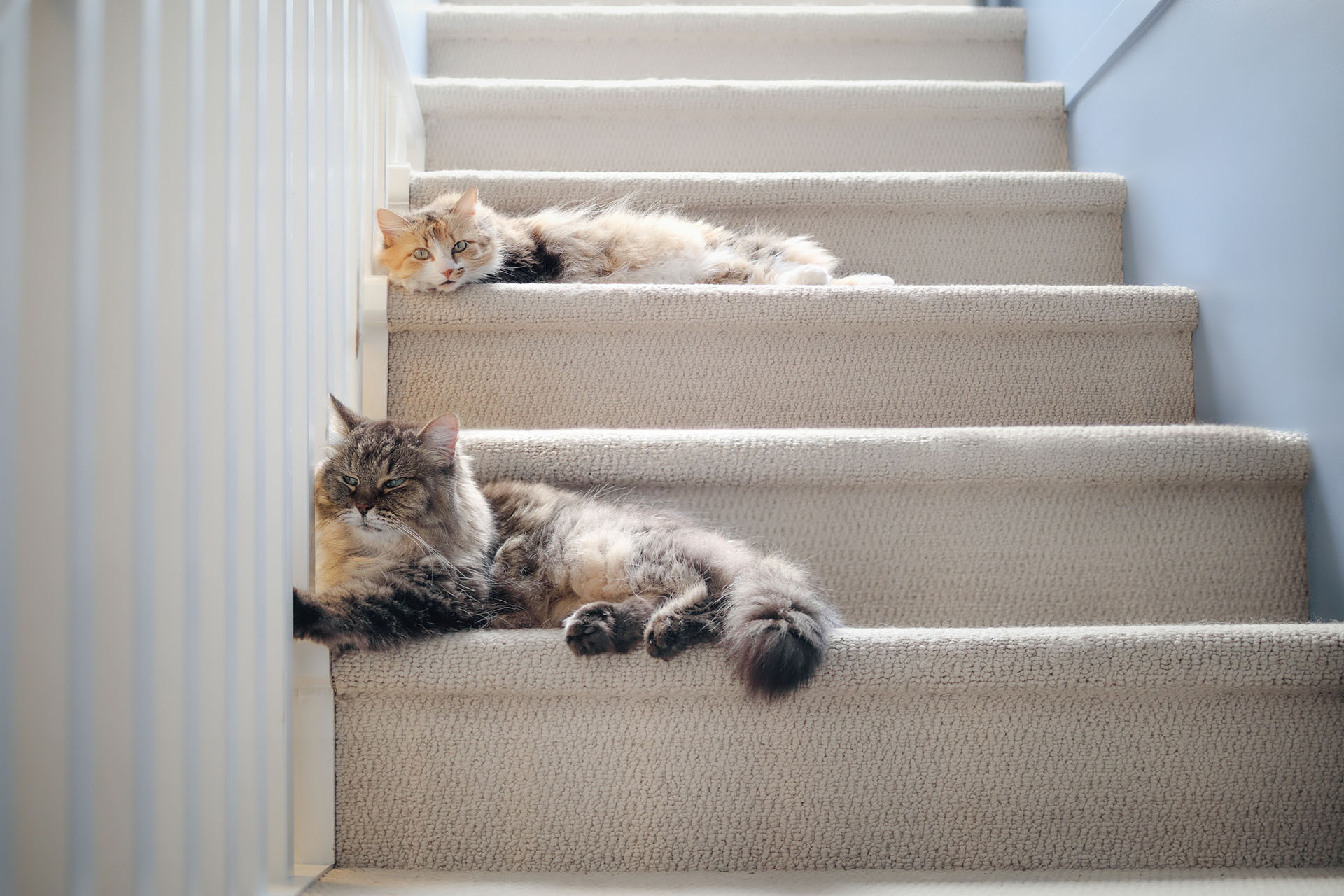
Stairs are also the one surface in a house where the wrong choice has a safety consequence rather than an aesthetic one. That is worth holding onto while you read the rest of this, because most comparisons of carpet vs hardwood stairs lead with appearance and treat traction as a footnote.
Safety And Traction On Stairs
On traction, carpet vs hardwood stairs is not a close contest. Carpet wins outright. It provides grip underfoot, it does not become slick in socks the way a finished wood or vinyl tread does, and if someone does go down, it absorbs part of the impact instead of transmitting all of it.
In our experience the households where this matters most are the obvious ones. Young children who take stairs at speed. Older adults, for whom a stair fall is a serious injury rather than a bruise. Dogs, which struggle for purchase on a hard tread and can develop a genuine reluctance to use the stairs at all.
Stairs are consistently among the leading sites of product-related injury in the home. The Consumer Product Safety Commission’s National Electronic Injury Surveillance System is the data set those figures come from, and adults over 65 and children under 5 carry the highest rates. Traction is the variable a homeowner actually controls.
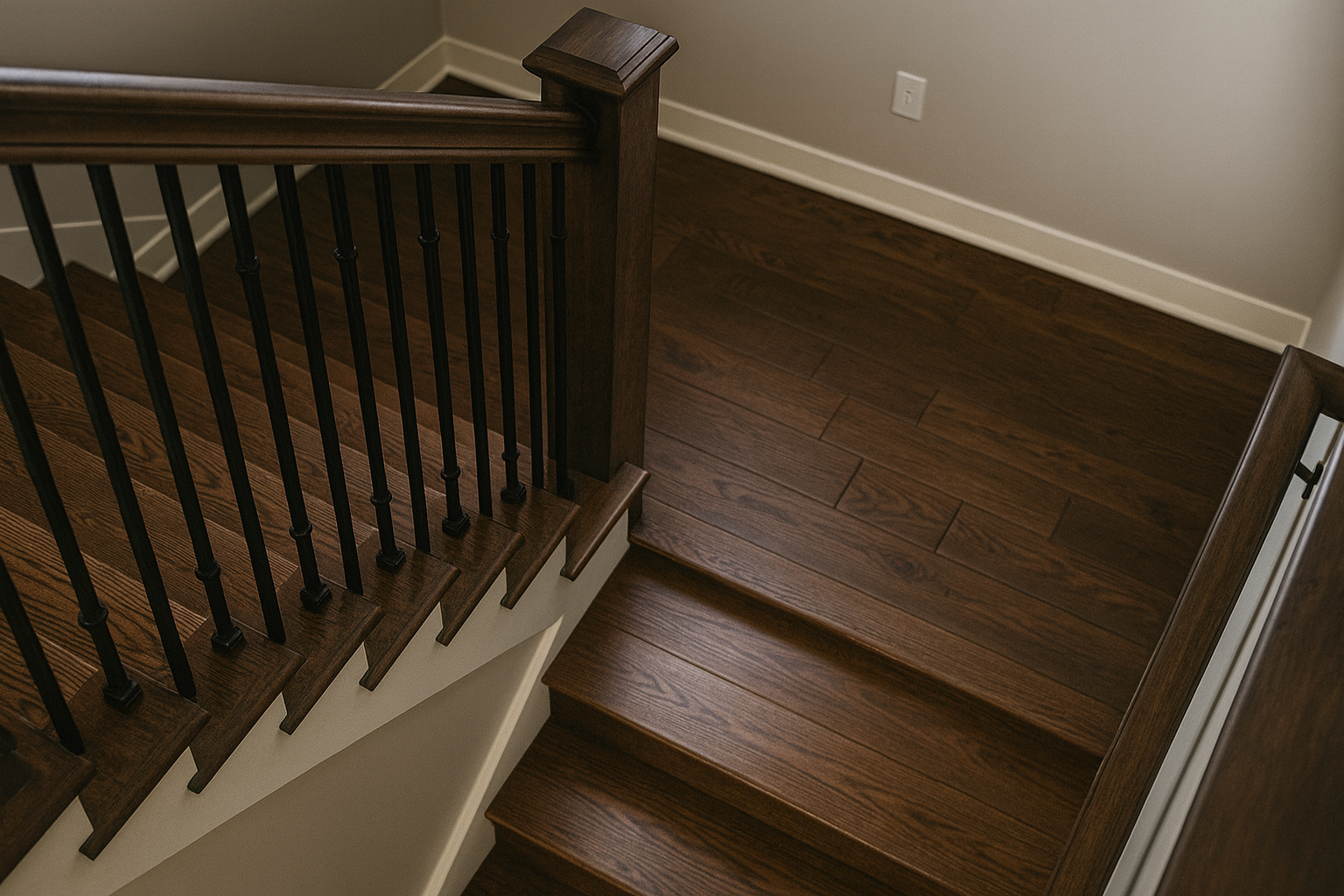
Hardwood and luxury vinyl plank stairs are not unsafe by definition, but they need help. That means either a runner down the center or a textured, low sheen finish rather than a high gloss one. A glossy stair tread looks excellent in a photograph and is the single slickest surface most people have in their home.
If anyone in the house has balance difficulty, do not put a high gloss finish on stair treads, and do not accept a runner that is only stapled at the top and bottom. A runner has to be secured at every tread, tight into the crotch where the tread meets the riser. A loose runner is more dangerous than a bare tread, because it moves under load without warning.
Noise, And Why Stairs Carry It
A staircase is built into the structure of the house, so it behaves like a drum skin stretched over the framing. Impact from a footstep does not stay at the stairs. It travels through the stringers into the floor joists and the walls, which is why hard stair treads are audible in rooms that do not touch the staircase.
This is the complaint we hear most often after someone puts hardwood or luxury vinyl plank on a staircase in a house with teenagers or shift workers. The floor looks exactly as intended and the house is suddenly much louder at six in the morning.
Carpet is the only stair surface that addresses this at the source rather than downstream, and the cushion underneath does most of the work. The cushion included with every carpet installation we do is a memory foam construction at 8 pounds per cubic foot density with a 2.0 R-value, and density is the spec that governs how much impact energy gets absorbed before it reaches the framing.
Carpet vs Hardwood Stairs: Where They Wear Out
Most guides state flatly that carpet on stairs wears out faster than carpet anywhere else in the house. That is true of a loosely constructed carpet and it is the reason stair carpet has a poor reputation. It is not a property of carpet. It is a property of density.
Pile density is calculated as 36 times the face weight divided by the pile thickness in inches, the formula the Carpet and Rug Institute publishes. Builder grade stair carpet frequently lands under 2,100, which on a staircase is a two or three year proposition. Above roughly 3,100 the same carpet on the same stairs behaves completely differently, because there is enough yarn packed into the pile that the nosing cannot crush flat. Our guide to carpet fibers and pile types walks through running that figure on a spec sheet.
Hardwood on stairs wears differently and more slowly. What fails is the finish at the nosing, not the wood, and on a solid tread that can be addressed without replacing anything. Laminate and luxury vinyl plank stair noses cannot be refinished, so when the wear layer at the edge goes, the piece is replaced. Our flooring lifespan comparison by material sets out how long each of these lasts on a flat floor, which is the generous version of what a staircase does to them.
Carpet vs Hardwood Stairs Compared
Here is how carpet vs hardwood stairs compare across the six factors that decide most staircases, with luxury vinyl plank included because it is the usual third option.
| Factor | Carpet | Hardwood | Luxury Vinyl Plank |
|---|---|---|---|
| Traction | Best. Grip in socks and bare feet | Slick, especially in high gloss | Slick, though texture helps |
| Impact noise | Absorbed at the source | Transmits into the framing | Transmits into the framing |
| Wear point | Pile crushes at the nosing | Finish wears at the nosing | Wear layer at the stair nose |
| Repairable | No. Replaced when crushed | Yes. Finish can be redone | No. The piece is replaced |
| Cleaning | Vacuuming stairs is awkward | Easiest. Sweep or damp mop | Easiest. Wipes clean |
| Best suited to | Children, older adults, dogs | Continuous look with wood floors | Continuous look, wet entries |
Laminate behaves much like luxury vinyl plank on stairs, with the difference that its core is not waterproof.
What We Install On Stairs
Every carpet we install is 100 percent solution dyed PET polyester in a texture cut pile. On a staircase that construction matters twice over. Texture cut pile hides tracking, which stairs show more than any flat floor, and there is no loop for a dog’s claw to catch and pull.
The pile density across the lines we carry runs from 3,600 to 4,480 with a twist of 5.75. Set that against the roughly 3,100 normally considered adequate for heavy traffic and against the builder grade stair carpet that often lands below 2,100, and the reason stair carpet has a reputation for going flat becomes clear. It is a specification problem, not a material one.
Solution dyed means the color is locked inside the fiber rather than applied to the surface. On a staircase that usually sits under a window or beside a landing with direct light, that is what stops the treads fading at a different rate from the rest. If the stairs are part of a larger job, our guide to hardwood floor direction covers how the landing above should run.
The Cushion Is The Part Most Warranties Exclude
Read the fine print on a cushion warranty and stairs are very often carved out, because stairs are where cushion gets destroyed. The cushion included with every carpet we install carries a 20 year transferable abrasive wear warranty that names stairs specifically as covered.
The rest of that specification matters on a staircase too. It runs 8 pounds per cubic foot with a 2.0 R-value and a memory foam construction, and it carries a moisture barrier with antimicrobial protection that stops a spill at the cushion instead of letting it run down inside the stairs, which is exactly how a smell gets into a staircase and stays there. It is Green Label Plus certified for indoor air quality and rated FHA and HUD Class 2.
Have Someone Look At Your Actual Staircase
Tread depth, riser height, whether the stairs are open on one side and whether there is a landing all change what can go down. A consultant measures the staircase itself and brings samples with the face weight, pile thickness and twist printed on the tag.
- Free In-Home Consultation
- Cushion Included On Every Carpet
- Licensed, Bonded And Insured
Call 877-356-6770
Carpet vs Hardwood Stairs: Which Suits Your Household
The carpet vs hardwood stairs question usually resolves quickly once you stop comparing materials and look at who actually uses the staircase every day.
Carpet vs hardwood stairs resolves toward carpet when anyone in the house is a young child, an older adult, or a dog. Bedrooms sit at the top of the stairs and noise carries. You want the quietest result available and you are prepared to vacuum stairs. Ask for the density figure before you agree to anything.
The floors above and below are already that material and the staircase breaking the sightline would bother you. The household is adults without mobility concerns. You accept a low sheen finish rather than a gloss, or you plan to add a runner.
You want the wood visible and the traction anyway, which is most people. Treads finished at the edges with carpet down the center is the compromise that actually holds up, provided it is fastened at every tread rather than at the ends.
You are drawn to a high gloss hardwood tread and someone in the house has balance difficulty. You are being quoted stair carpet without being told the density. Or you are planning tile on stairs, which is rarely appropriate in a home because of the hardness and the traction.
Mistakes We See On Stairs
Cushion compresses over the life of a carpet, and on stairs it compresses hardest at the nosing. New carpet over a flattened cushion crushes early in exactly the place you were trying to fix.
Face weight without pile thickness tells you nothing, because density needs both. A heavy carpet built tall can be less dense than a lighter one built short.
Hardwood, laminate and luxury vinyl plank stairs need a manufactured stair nose. A square cut edge is a trip point, it chips, and it works loose. If a quote does not mention stair nose pieces, ask why.
Stairs take far longer to install than the same area of flat floor and need their own measurement. Decide them at the same time as the floors, not after. And do not assume the stairs must match the floor. A deliberate change at the staircase reads as intentional.
Questions Homeowners Ask About Stairs
Is carpet or hardwood better on stairs?
Carpet is better for safety and noise, and hardwood is better for cleaning and for a continuous look with wood floors. If there are young children, older adults or dogs in the house, carpet is the stronger choice. If the household is adults and the floors above and below are wood, hardwood makes sense with a low sheen finish or a runner.
Are hardwood stairs slippery?
Yes, particularly in socks and particularly with a high gloss finish. The finish matters more than the wood. A low sheen or textured finish improves grip, and a runner secured at every tread solves it outright while leaving the wood visible at the edges.
Does carpet on stairs wear out faster?
Loosely constructed carpet does, because stairs concentrate every footfall onto the nosing. Density is what changes the outcome. Builder grade stair carpet often sits below 2,100, while the carpets we install run 3,600 to 4,480, and at that density the pile does not crush flat at the edge.
What is the quietest flooring for stairs?
Carpet over a dense cushion. A staircase transmits impact sound into the framing of the house, so hard treads are audible in rooms that do not touch the stairs. Cushion density governs how much of that energy is absorbed before it reaches the structure.
Can you put luxury vinyl plank on stairs?
Yes, with matching stair nose pieces made for the product. Plank cannot simply be cut square at the tread edge. It handles moisture better than laminate and wipes clean easily, which suits a staircase off an entry, but it is slick in socks in the same way hardwood is.
Is a stair runner a good idea?
For most households, yes. A runner gives traction and noise absorption while leaving finished tread edges visible. It has to be fastened at every tread and pulled tight where the tread meets the riser. A runner secured only at the top and bottom moves underfoot and is more hazardous than a bare tread.
Do the stairs have to match the upstairs floor?
No. A staircase is a natural break in a sightline, so changing material there reads as a deliberate choice rather than a mismatch. Carpeted stairs between hard floors on both levels is a common and deliberate combination.
Does Go Flooring install stairs?
Yes. We install new flooring on stairs in carpet, hardwood, laminate and luxury vinyl plank across North Carolina, South Carolina, Georgia, Florida, Alabama, Michigan, Indiana and Ohio. We install new floors only, so refinishing existing treads is not something we take on.
Book A Free In-Home Consultation
See how a sample looks on your own staircase, in your own light, before you decide. No obligation and no pressure. If a runner is the better answer for your household, we will tell you that.
- A+ BBB Rated
- Free Consultation And Samples
- Licensed, Bonded And Insured
Call 877-356-6770
Why Homeowners Trust Go Flooring
4.8 Google Average
2026 Gold Titan Award
Lifetime Installation Warranty

