
Quick Answer
For most kitchens, luxury vinyl with a 20-mil or thicker wear layer over a waterproof core is the best kitchen flooring, because it handles spills, dropped pans and long hours of standing. Porcelain and ceramic tile last 50 to 75+ years but are harder underfoot. Laminate and hardwood can work, with conditions.
Key Notes
- Wear layer: 20-mil and 22-mil luxury vinyl wear layers are commercial-grade and run 20 to 30 years, while 6-mil and 8-mil layers often show wear in 7 to 10.
- Tile lifespan: porcelain and ceramic tile last 50 to 75+ years, with grout resealing every 2 to 3 years as the main upkeep.
- Wet slip resistance: ANSI A326.3 sets a wet DCOF of 0.42 or higher for level interior floors expected to be walked on when wet.
- Laminate rating: our top-selling laminate is AC4-rated, 8mm thick with a 2mm attached pad, and carries a 10-year waterproof warranty for everyday spills and damp mopping.
- Humidity: hardwood stays stable at 30 to 50 percent indoor humidity and 60 to 80 degrees Fahrenheit, per NWFA guidance.
- Subfloor flatness: floating floors need a subfloor flat within 3/16 inch over 10 feet, or planks flex and seams separate over the low spots.
Test Samples Against Your Cabinets and Light
A Go Flooring consultant brings luxury vinyl, tile, laminate and hardwood samples to your home, evaluates the subfloor, and walks through which material suits your kitchen. Call 877-356-6770 to schedule a free in-home consultation.
- Free In-Home Consultation
- Subfloor Evaluated On Site
- A+ BBB Rated
What This Guide Covers
- What Makes Kitchen Flooring Different From Other Rooms?
- Kitchen Flooring Compared: Four Materials Side by Side
- Luxury Vinyl: The Best Kitchen Floor for Most Homes
- Porcelain and Ceramic Tile: The Most Water-Tolerant Kitchen Floor
- Laminate in the Kitchen: Workable With the Right Product
- Hardwood in the Kitchen: Possible, With Tradeoffs
- Why Carpet Stays Out of the Kitchen
- Where Kitchen Floors Fail First
- Which Kitchen Flooring Fits Your Household?
- Kitchen Flooring Questions Homeowners Ask
What Makes Kitchen Flooring Different From Other Rooms?
A kitchen asks more of a floor than any other dry room in the house. Water reaches it from the sink, the dishwasher and the refrigerator line, often slowly and out of sight. Pans, glass jars and cast iron land on it. People stand on it for an hour at a time, and in an open floor plan it usually has to flow into the living area next to it.
That combination is why kitchen flooring gets judged on five things, in roughly this order: how the material responds to water, how it takes an impact, how slick it gets when wet, how it feels after a long stretch at the counter, and how many years of service it delivers. A floor that wins on looks and loses on the first two tends to show it early.
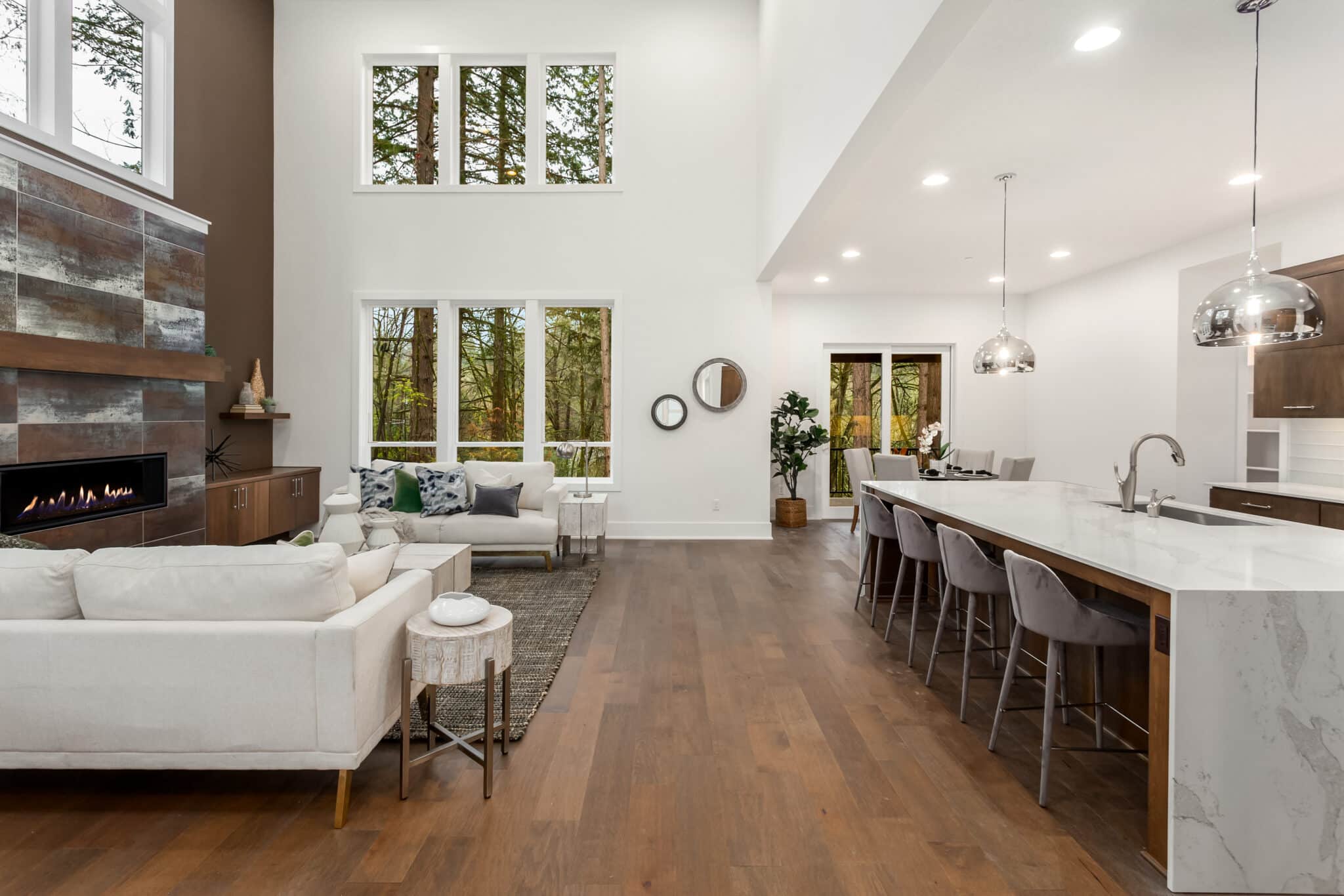
The mistake we see most often in kitchens is a floor chosen for the living room and carried through the doorway. Sometimes that works. It works when the material was right for the kitchen to begin with, and it fails when it was not, which is why the kitchen should set the material for an open main level rather than the other way around.
Four of the five materials Go Flooring installs belong in this conversation: luxury vinyl, porcelain and ceramic tile, laminate, and hardwood. Carpet is the fifth, and it has real strengths in bedrooms and on stairs, but a kitchen is not one of its rooms. The sections below take each hard surface in turn, starting with the one that fits the widest range of kitchens.
Kitchen Flooring Compared: Four Materials Side by Side
The table puts the four hard surfaces against the kitchen stresses that matter most. Every figure comes from manufacturer spec sheets or published industry ranges rather than adjectives.
| Kitchen Flooring | Water at the Sink | Dropped Pans and Dishes | Standing Comfort | Typical Service Life |
|---|---|---|---|---|
| Luxury vinyl (plank and tile looks) | Waterproof core; a hidden leak can still reach the subfloor | Rigid core resists dents; 20 to 22 mil wear layer resists scratches | Softer and warmer than tile | 20 to 30 years at 20 mil and up |
| Porcelain and ceramic tile | Tile is unaffected by water; grout needs resealing every 2 to 3 years | Hardest surface; dropped glass breaks and a heavy impact can crack a tile | Hardest underfoot; a cushioned mat helps at the sink | 50 to 75+ years |
| Laminate (AC4, attached pad) | 10-year waterproof warranty for everyday spills and damp mopping; standard laminate swells at the seams | AC4 surface built for active households | 2mm attached pad adds cushion | 15 to 25 years certified; 8 to 12 years for standard laminate in a kitchen |
| Hardwood (solid and engineered) | Not waterproof; standing water cups and stains boards | Dent resistance varies by species, from 950 to 1,820 Janka | Slight give and warm underfoot | 50 to 100+ years solid; 25 to 50 engineered with a 4mm+ veneer |
Service life assumes normal residential use over a correctly prepared subfloor. Service-life ranges are published industry figures; the laminate AC rating, pad and warranty come from the product spec sheet.
For the reasoning behind each range, including what shortens a floor's life and what extends it, see our full lifespan comparison by material. The short version for a kitchen: tile and hardwood outlast everything else when water is managed, and luxury vinyl delivers the most day-to-day forgiveness while it lasts.
Luxury Vinyl: The Best Kitchen Floor for Most Homes
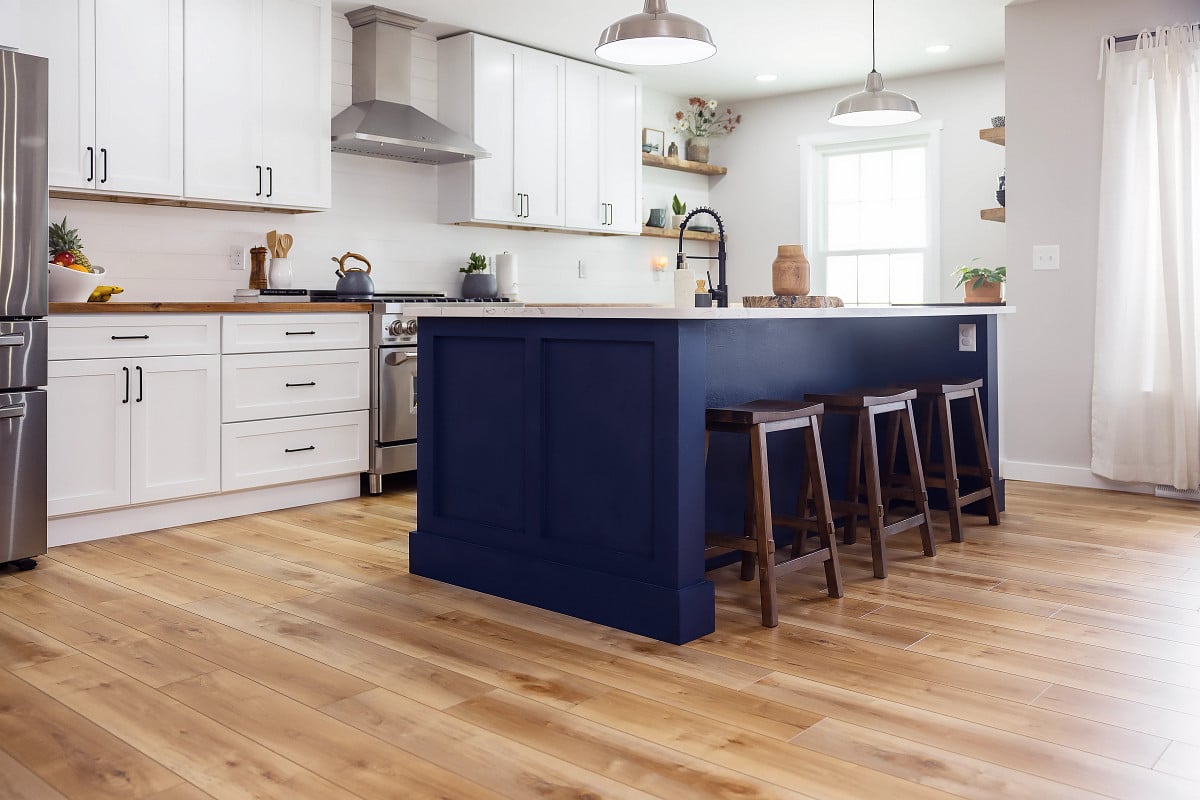
Luxury vinyl is the best kitchen flooring for most homes because it combines a waterproof core, real dent resistance and a softer stand than tile. It comes in two looks built on the same construction: plank formats that read as wood, and tile formats that read as stone or ceramic with no grout to seal.
The Wear Layer Number Is the Whole Decision
The clear top layer, measured in mils, takes the scuffs from chair legs and the grit from shoes. Entry-level products use 6 or 8 mil and often show visible wear in 7 to 10 years. A 12-mil layer is solid residential grade. The top-selling luxury vinyl lines we install carry 20 and 22 mil wear layers, the range classed as commercial-grade for residential use and good for 20 to 30 years.
Core Type and Plank Thickness
Below the wear layer sits the core. SPC, a stone plastic composite, is dense and rigid, which helps it resist dents from a dropped pan and bridge small subfloor imperfections. WPC is a foamed core that feels a little softer and warmer underfoot but gives up some impact resistance. For thickness, 5mm is the residential minimum, and 6.5mm to 8mm performs noticeably better over a subfloor that is out of flat.
Indoor air is worth a line too, since a kitchen is where a family spends much of its day. The rigid core lines we carry are FloorScore certified, which means their VOC emissions have been independently verified against California's Section 01350 criteria. The Resilient Floor Covering Institute explains how FloorScore certification works on its site.
Where Luxury Vinyl Falls Short
Heat is the first limit. Manufacturers cap surface temperature at roughly 140 degrees Fahrenheit, so a large window that bakes one strip of floor every afternoon deserves a conversation before install. The second limit is that luxury vinyl cannot be refinished; a badly gouged plank gets replaced rather than sanded. Our luxury vinyl flooring page covers the plank and tile formats available.
A waterproof plank protects itself, not the subfloor beneath it. Water from a slow dishwasher or ice-maker leak can travel along the seams and under the edges of any floating floor. Fix leaks at the source, and treat a swollen cabinet toe kick or a musty smell under the sink as an early warning.
Porcelain and Ceramic Tile: The Most Water-Tolerant Kitchen Floor
Porcelain and ceramic tile is the most water-tolerant kitchen flooring Go Flooring installs. The tile body does not swell, cup or stain from water, and a well-installed tile floor runs 50 to 75 years or more. It suits a homeowner who plans to stay put and wants a floor that will not drive the next remodel.
Porcelain is the denser of the two, defined under ANSI A137.1 as tile that absorbs 0.5 percent of its weight in water or less. Glazed ceramic is lighter and easier to cut, and its glazed face handles kitchen spills just as well. Browse our porcelain and ceramic tile options for formats and finishes.

Grout Is the Maintenance Item
The tile itself rarely fails. Grout is the part that ages. Plan on cleaning grout lines yearly, resealing every 2 to 3 years, and full grout replacement every 10 to 15 years. Larger tiles mean fewer grout lines to maintain, which is a practical argument for bigger formats in a busy kitchen. Grout care falls to the homeowner or a specialty provider, since Go Flooring focuses on new installation.
Slip Resistance When the Floor Is Wet
A wet kitchen floor is a real hazard, so check the slip rating on any tile you consider. ANSI A326.3 measures dynamic coefficient of friction, or DCOF, and hard surface flooring for level interior spaces expected to be walked on when wet should test at a wet DCOF of 0.42 or greater. The Tile Council of North America publishes the ANSI A326.3 slip resistance standard as a free download. Treat the number as a comparison between products, not a guarantee against a fall.
The Tradeoff: Hard Underfoot
Tile is the hardest surface in the lineup, so a dropped glass usually breaks and a long session at the stove is felt in the feet. A cushioned mat at the sink and range answers most of the comfort complaint. Tile also holds the temperature of the room, which homeowners in Michigan notice in January and homeowners in Florida welcome in August.
Laminate in the Kitchen: Workable With the Right Product
Laminate is where kitchen advice most often goes wrong, in both directions. Generic guides warn that laminate swells in a kitchen, and standard laminate does: water that sits at the seams swells the core, and standard laminate typically lasts 8 to 12 years in a kitchen for that reason. Laminate built for wet-prone rooms is a different product, and it is a reasonable choice for kitchen flooring when you choose it by its specs and its warranty terms.
Our top-selling laminate shows what to look for. Its surface is rated AC4 for abrasion, the class built for active households. It measures 8mm with a 2mm attached pad for cushion and sound. The product also carries a 10-year waterproof warranty written around everyday spills and damp mopping, plus a lifetime pet stain warranty. Read those terms closely, because a supply-line leak left overnight is a different question from a spill wiped up the same day.
When Laminate Makes Sense as Kitchen Flooring
Laminate fits a kitchen where the household wants a wood look on a scratch-resistant AC4 surface and spills get wiped up rather than left. It is a weaker fit beside a dishwasher with a history of leaks, or in a kitchen that doubles as the route in from a pool or a muddy yard. Unlike hardwood, laminate cannot be refinished, so a damaged plank gets replaced.
Hardwood in the Kitchen: Possible, With Tradeoffs
Hardwood can work as kitchen flooring, and many homeowners want it there because it lets one real wood floor run from the kitchen through the main level. It is also the least forgiving of water in the lineup. Hardwood is not waterproof, and water left on the surface or leaking underneath can cup, stain or lift boards.
Humidity matters as much as spills. The National Wood Flooring Association recommends keeping a home between 60 and 80 degrees Fahrenheit and 30 to 50 percent humidity year-round, because wood swells as it gains moisture and shrinks and gaps as it dries. Its homeowner guidance on seasonal humidity and wood floors explains the effect. Kitchens add cooking steam to that equation.

Species Hardness and Dropped Pans
The Janka rating measures the force it takes to dent a species, and it is the number to check before hardwood goes near a range. American cherry sits at 950 and American walnut at 1,010, soft enough that a dropped pan leaves a mark. Red oak is 1,290, white oak 1,360, hard maple 1,450 and hickory 1,820. For a working kitchen, 1,290 and up is the practical starting point.
Solid or Engineered
Engineered hardwood, a real wood veneer over a layered core, moves less with humidity than solid hardwood, which makes it the steadier choice for most kitchens. Solid hardwood lasts 50 to 100+ years and can be refinished 4 to 6 times. Engineered hardwood with a 4mm or thicker veneer runs 25 to 50 years and can be refinished once or twice. Refinishing is work for a specialty provider rather than a Go Flooring service, but the capability is part of why hardwood holds its value.
Why Carpet Stays Out of the Kitchen
Carpet is one of the five materials Go Flooring installs, and it earns its place in bedrooms, family rooms and on stairs, where warmth, quiet and a softer landing matter. It is the wrong choice for kitchen flooring. Food, grease and water reach a kitchen floor every day, and a stain that is a rare event in a bedroom becomes routine beside a stove. If comfort underfoot is what draws you toward carpet, luxury vinyl or laminate with an attached pad gets closer to that feel on a surface that wipes clean.
Where Kitchen Floors Fail First
In our experience, damage to kitchen flooring rarely begins in the middle of the room. It begins where water, weight or standing time concentrate, and each of those spots asks something different of the material.
| Kitchen Zone | What Stresses the Floor | Material That Handles It |
|---|---|---|
| Sink and dishwasher | Splashes, drips and slow supply-line leaks | Tile or luxury vinyl; laminate only with a waterproof warranty |
| Refrigerator and ice maker | Water line leaks hidden behind the unit | Tile or luxury vinyl |
| Range and oven | Dropped cookware and grease | Tile, rigid core luxury vinyl, or hardwood at 1,290 Janka and up |
| Island and prep counters | Hours of standing in one spot | Luxury vinyl or laminate with an attached pad |
| Opening to the living area | Visual continuity and a level transition | One material that suits both rooms |
Match the kitchen flooring to the most demanding zone in the room, since a single floor usually covers all of them.
Under every zone sits the subfloor. Floating floors need a subfloor flat within 3/16 inch over a 10-foot span; beyond that, planks flex over the low spots and seams work loose. Go Flooring evaluates subfloor conditions during the free in-home consultation, before any product is ordered.

If the kitchen opens to a living or dining area, the floor decision covers both rooms. Our guide on whether flooring should match throughout the house covers when one continuous material reads better and when a change at the doorway makes sense.
Which Kitchen Flooring Fits Your Household?
Use the household, not the photo, to narrow the kitchen flooring list. Each card below starts from a common kitchen situation and points to the material that suits it.
You have kids, pets or a busy cooking schedule, you want a wood or stone look, and you want waterproof construction with a softer stand than tile. Look for a 20-mil or thicker wear layer and a rigid core.
You plan to stay in the home for decades, you want the most water-tolerant surface available, and you are comfortable with a hard floor and grout resealing every 2 to 3 years. Confirm a wet DCOF of 0.42 or higher.
You want a wood look on an AC4-rated surface, spills get wiped up quickly, and the product carries a waterproof warranty. Skip standard laminate, which typically lasts 8 to 12 years in a kitchen.
You want real wood running through an open main level, you can hold indoor humidity at 30 to 50 percent, and you pick a species at 1,290 Janka or harder. Engineered hardwood is the steadier kitchen option.
A floor that suits the living room can fail beside the dishwasher. Rank the kitchen's water, traffic and standing time first, then pick a style within the materials that pass. Our list of the most common flooring buying mistakes walks through the rest.
Kitchen Flooring Questions Homeowners Ask
What is the best flooring for a kitchen?
For most kitchens, luxury vinyl with a 20-mil or thicker wear layer and a waterproof core is the best balance of water resistance, dent resistance and comfort. Porcelain or ceramic tile lasts longer, at 50 to 75+ years, but is harder underfoot and needs grout upkeep.
Is luxury vinyl plank good for kitchens?
Yes. Luxury vinyl plank with a waterproof core handles spills and mopping, and a 20-mil or 22-mil wear layer resists scratches for 20 to 30 years. Its limits are surface heat above roughly 140 degrees Fahrenheit and hidden leaks that reach the subfloor.
Is tile or LVP better for a kitchen?
Tile lasts longer, at 50 to 75+ years, and is unaffected by water, but it is hard underfoot and grout needs resealing every 2 to 3 years. Luxury vinyl is softer, quieter and waterproof, with a 20 to 30 year service life at 20 mil and up.
Can you put laminate flooring in a kitchen?
Yes, if you choose laminate built for it. Look for an AC4 rating and a waterproof warranty covering everyday spills and damp mopping. Standard laminate without that protection can swell at the seams in a kitchen within 8 to 12 years.
Is hardwood flooring OK in a kitchen?
Hardwood works in a kitchen if spills are wiped up quickly, indoor humidity stays between 30 and 50 percent, and the species rates 1,290 Janka or harder. Engineered hardwood moves less with humidity than solid. Hardwood is never waterproof, so leaks are its main risk.
What is the most slip-resistant kitchen flooring?
Slip resistance depends on the specific product and finish, not just the material. For tile and other hard surfaces, check the wet DCOF rating under ANSI A326.3. Level interior floors expected to get wet should test at 0.42 or higher.
Should kitchen flooring match the rest of the house?
In an open floor plan, one continuous material usually reads better than a change at the kitchen edge. That only works if the material suits the kitchen, which makes luxury vinyl, tile and engineered hardwood the common choices for a whole main level.
How long does kitchen flooring last?
It depends on the material. Porcelain and ceramic tile last 50 to 75+ years, solid hardwood 50 to 100+ years, luxury vinyl with a 20-mil wear layer 20 to 30 years, and certified laminate 15 to 25 years. Standard laminate often lasts 8 to 12 in a kitchen.
Choose Your Kitchen Floor at Home
Put the samples on your own kitchen floor, next to your cabinets and under your lighting, before you decide. A consultant evaluates the subfloor on the same visit.
- Free In-Home Consultation
- Install As Fast As Tomorrow
- Licensed and Insured
Or call 877-356-6770.

