
Quick Answer
How long flooring lasts comes down to the material, which is why the useful answer is lifespan by material. Solid hardwood leads at 50 to 100+ years, with tile close behind at 50 to 75+. Luxury vinyl plank and quality laminate fall in the middle at 15 to 30 years. Carpet trails at 5 to 15 years.
Key Notes
- Solid hardwood: 50 to 100+ years, refinishable 4 to 6 times across its lifespan
- Tile: 50 to 75+ years for the tile itself; grout typically needs full renewal every 10 to 15 years
- Premium LVP: 20 to 30 years with a 20-mil or thicker wear layer; budget LVP fails inside 10
- Quality laminate: 15 to 25 years, with NALFA-certified products at the top of that range
- Carpet: 5 to 15 years depending on pile density, twist, and traffic load
- Engineered hardwood: 25 to 50 years, refinishable once or twice with a 4mm or thicker veneer
Table of Contents
- What “Lasts” Actually Means
- Lifespan By Material At A Glance
- Solid and Engineered Hardwood
- Tile
- Luxury Vinyl Plank
- Laminate
- Carpet
- What Shortens Flooring Life
- What Extends It
- Choosing for Longevity
- Frequently Asked Questions
What “Lasts” Actually Means
Before comparing numbers, it helps to define what we’re measuring. A floor’s lifespan isn’t a single number on a spec sheet. It’s a range that depends on what’s installed, how it’s installed, where it’s installed, and how it’s lived on.
There’s a real difference between “still functional” and “still looks good.” Carpet might be technically usable at year 15 but matted, stained, and tired enough that no one wants it underfoot anymore. A 60-year-old oak floor might show surface scratches and a few water stains, yet a single sand-and-refinish cycle brings it back to looking new in three days. That refinishability is the single biggest variable in real-world lifespan, and it’s where some materials pull dramatically ahead of others.
Our crews install flooring across North Carolina, South Carolina, Georgia, Florida, Alabama, Michigan, Indiana and Ohio, and the patterns we see in 30-year-old homes are consistent. The floors that survive are built from durable materials, installed over properly prepared subfloors, and maintained with the right products. The floors that fail early almost always trace back to one of those three things.
Lifespan By Material At A Glance
Here’s the at-a-glance breakdown of lifespan by material: how each of the five core flooring categories holds up over time, what fails first, and where each one is at its best.
| Material | Realistic Lifespan | Refinishable? | Primary Failure Mode | Where It Shines |
|---|---|---|---|---|
| Solid Hardwood | 50 to 100+ years | Yes, 4 to 6 times | Moisture damage, humidity cupping | Living, dining, bedrooms with stable humidity |
| Engineered Hardwood | 25 to 50 years | Yes, with 4mm+ veneer (1 to 2 times) | Veneer wear-through, edge separation | Basements, slab-on-grade, humid climates |
| Tile | 50 to 75+ years (tile); grout 10 to 15 | Tile no; grout yes | Cracking from substrate movement, grout failure | Bathrooms, kitchens, mudrooms, entries |
| Luxury Vinyl Plank | 15 to 30 years | No; individual planks replaceable | Wear-layer breakdown, seam separation, UV fading | Full-home installs, kitchens, basements, pets |
| Laminate | 15 to 25 years (NALFA-certified) | No | Edge swelling from water, image-layer wear | Bedrooms, hallways, dry living areas |
| Carpet | 5 to 15 years | No; cleaning extends life | Matting, soiling, fiber crush in traffic lanes | Bedrooms, family rooms, basements (low moisture) |
Solid and Engineered Hardwood: 50 to 100+ Years

Solid hardwood is the longevity champion of residential flooring. Walk through a home built in the 1920s with original oak floors and you’ll see what’s possible. Real oak, properly installed and maintained, can outlast the framing of the house it sits in. The reason it lasts is structural: a 3/4-inch solid hardwood plank can be sanded and refinished four to six times across its lifespan. Each refinish removes roughly 1/32 of an inch of wood, which means decades of surface restoration are available before the tongue-and-groove joint gets compromised.

Engineered hardwood is a different conversation. Its lifespan depends almost entirely on the thickness of the wear veneer. A premium engineered hardwood with a 4mm or thicker veneer can be refinished one to two times and will run 25 to 50 years. The 2mm budget engineered products that show up in big-box stores can’t be refinished, and they typically need replacement around year 20 to 25.
The National Wood Flooring Association publishes installation and maintenance standards that, when followed, push hardwood to the top of its lifespan range. The two biggest threats to a hardwood floor are moisture and humidity swings, both of which cause cupping, gapping, and finish failure. Homes that hold indoor humidity between 30 and 50 percent year-round get the longest service out of their hardwood, which is one reason climate control matters so much across the Southeast.
Tile: 50 to 75+ Years for the Surface
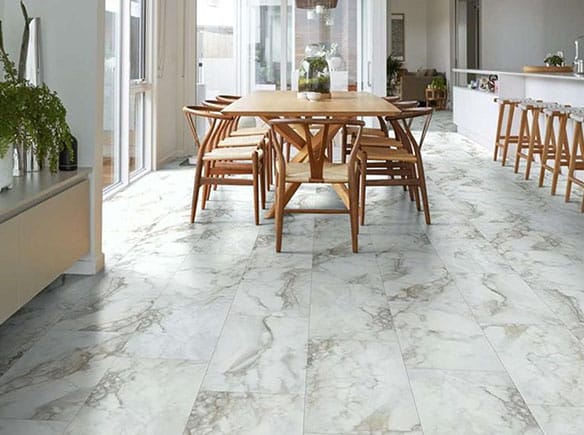
Tile is the other heavyweight, and in some ways it actually outlasts hardwood. Ceramic and porcelain tiles themselves don’t really wear out in residential use. They chip, they crack under impact, but the material itself doesn’t degrade the way wood, vinyl, or fibers do. When decades-old ceramic tile comes out of a kitchen, it is usually the style being replaced, not a worn-out surface. Both ceramic and porcelain are part of the tile flooring we install.
The catch with tile is the grout. Grout is a porous, cement-based material that absorbs stains, harbors mold, and degrades faster than the tile around it. Most grout lines need cleaning every year, resealing every two to three years, and full replacement every 10 to 15 years. A well-maintained tile floor with periodically renewed grout can run 50 to 75 years before the tile itself becomes a problem.
The Tile Council of North America publishes the TCNA Handbook for Ceramic, Glass, and Stone Tile Installation, which has been the industry installation reference for decades. Tile installed to TCNA specifications, over a proper mortar bed and with the right movement joints, essentially has a structural lifespan rather than a wear lifespan. The failure modes we see in tile are almost always installation-related: missing waterproofing in bathrooms, no expansion joints in large floors, or thin-set applied over an unstable substrate.
Luxury Vinyl Plank: 15 to 30 Years
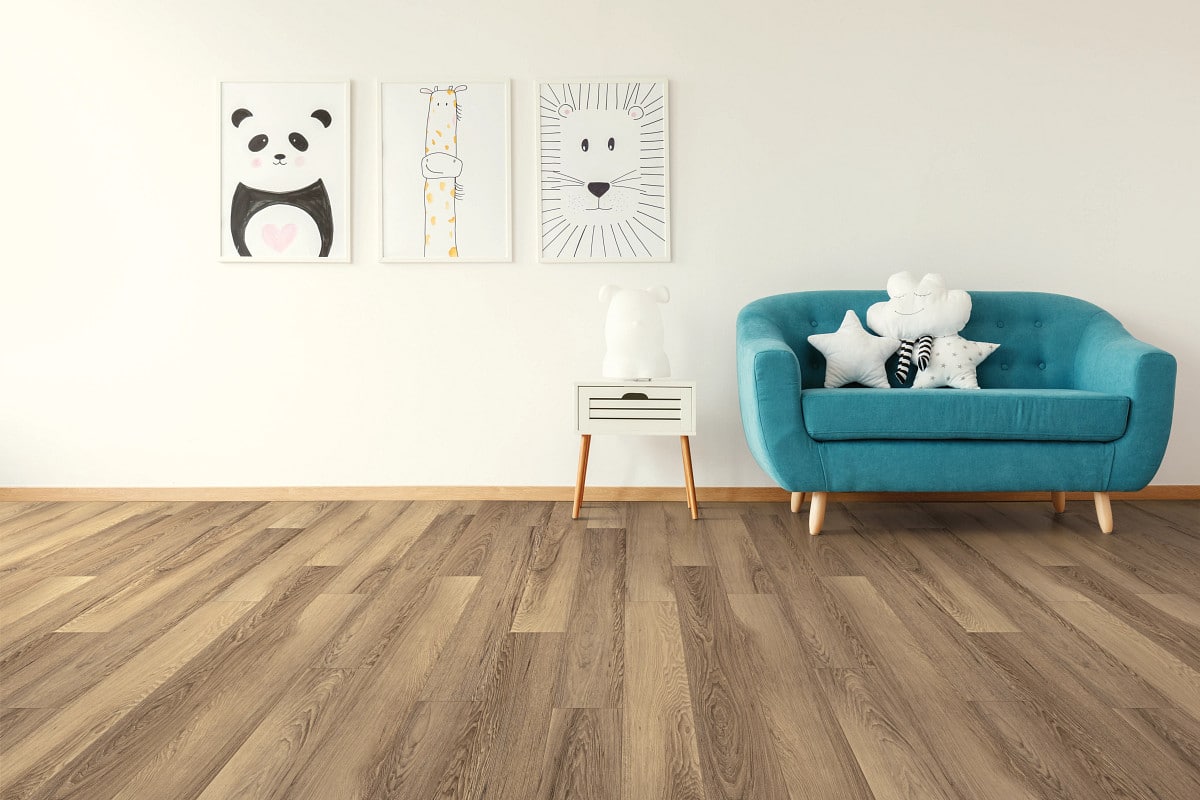
LVP is the most variable category on this list. The gap between a budget LVP and a premium LVP is enormous, and lifespan tracks directly with wear-layer thickness and core construction.
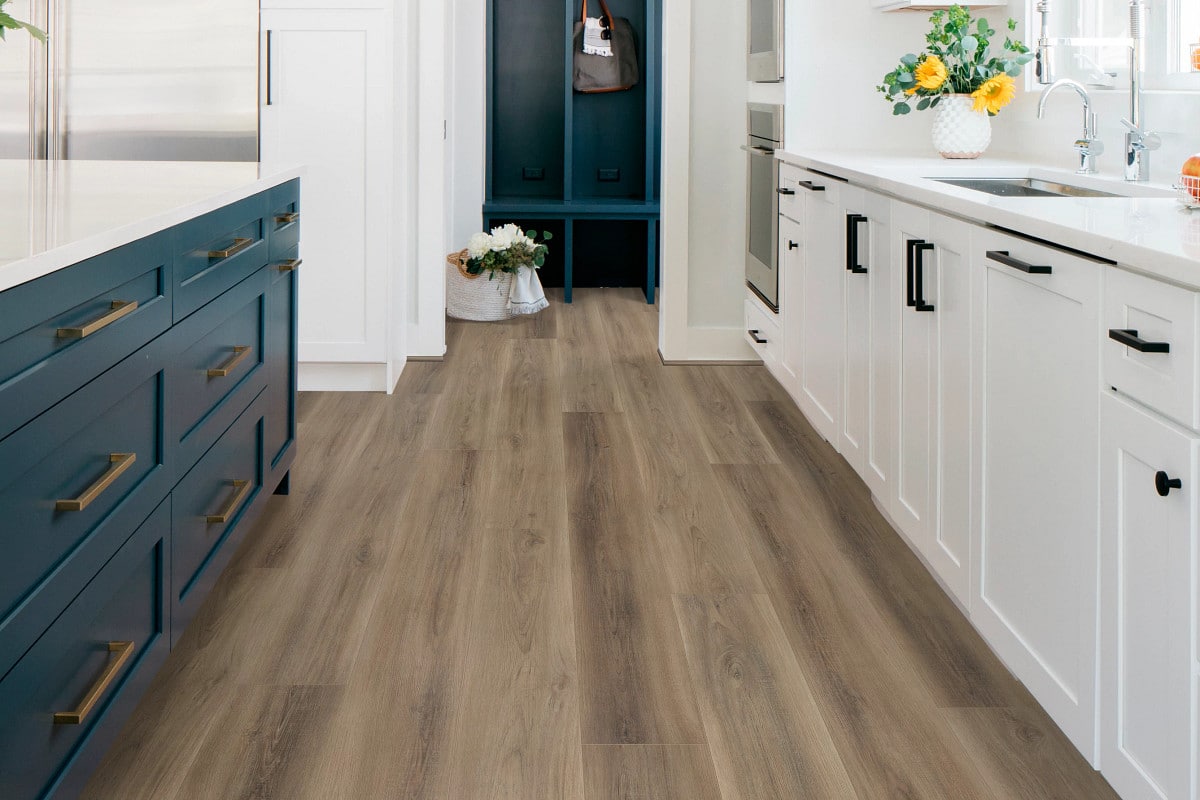
A 6-mil wear-layer LVP installed in a busy household will show wear-through in 7 to 10 years. A 20-mil or thicker wear layer over an SPC (stone plastic composite) core, installed properly over a flat subfloor, can run 25 to 30 years before the wear layer breaks down. Wear layers of 20 and 22 mil are commercial-grade thicknesses, and they deliver the longest service life in homes. The luxury vinyl plank we install carries a 20 or 22-mil wear layer over an SPC core.
What ends an LVP floor early is rarely the surface. It’s the edges and seams. UV exposure in south-facing rooms can cause expansion that eventually compromises click-lock joints. Entry-level LVP in kitchens can fail at the seams when water finds its way through. Heavy furniture left in one place can compress softer cores. Once those structural failures start, LVP can’t be refinished, so the only fix is plank replacement.
We’ve walked into homes where premium LVP installed over a decade ago still looks fresh, and we’ve inspected newer budget installs already showing seam separation after a few years of use. The product tier matters that much.
Laminate: 15 to 25 Years

Quality laminate is more durable than its reputation suggests, but the category got dragged down by years of entry-level product flooding the market. The North American Laminate Flooring Association certifies laminate under its NALFA product certification standards, which test wear, impact, moisture and dimensional stability. NALFA-certified laminate runs 15 to 25 years in normal residential service.
Budget laminate (the tier that’s flooded big-box stores for years) typically shows visible wear at high-traffic spots in 7 to 10 years. The image layer fades, the edges chip, and water damage from spills or mop water causes swelling at the seams that can’t be undone.
Water is where laminate gets judged. Standard laminate has a fiberboard core that swells permanently when it gets wet, and a swollen plank cannot be sanded down or restored. Water-resistant laminates have improved on that, but moisture performance varies by product, so wet rooms still usually go to premium SPC luxury vinyl plank or tile.
The laminate we install is rated AC4 with a 2mm pad attached to the plank, and it performs best where laminate always has: bedrooms, hallways and dry living areas.
Carpet: 5 to 15 Years
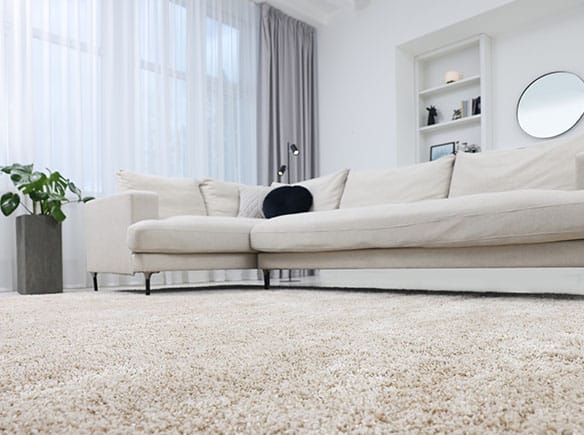
Carpet has the shortest lifespan of any flooring category, and the range within carpet is wider than most homeowners realize. A loosely built carpet in a busy household with kids and pets might be matted, stained, and ready for replacement in 5 years. A dense, high-twist carpet in a low-traffic master bedroom can easily run 15+ years and still look reasonably fresh.
The Carpet and Rug Institute guide to selecting carpet credits tuft density and yarn twist with the durability of a cut pile, and those are the specs that separate a carpet that lasts from one that doesn’t. The numbers that matter are face weight, pile thickness, pile density, and twist. Density is the one to run yourself: 36 times face weight divided by pile thickness in inches.
As a trade rule of thumb, results above 3,100 suit a busy household and anything under 2,100 is light duty only. Twist runs 2.5 to 6.0 twists per inch (TPI), and a higher figure is what keeps a cut tuft from blooming open and matting. Our guide to carpet fibers and pile types runs those numbers on a real spec sheet.
What kills carpet isn’t the fiber wearing through. It’s matting, set-in soiling, and crushed pile in traffic lanes that the fiber can’t fully release. The maintenance program (vacuuming with a properly adjusted beater bar weekly, professional hot-water extraction at the interval your manufacturer requires) is the single biggest factor that determines whether a carpet hits 5 years or 15.
What Shortens Flooring Life
In our experience, the fastest way to take years off any flooring is to install it over the wrong subfloor. It is a pattern that shows up again and again in failed work from prior installers. Hardwood nailed to a subfloor with too much deflection. LVP click-lock joints fracturing because the subfloor is out of flat by half an inch across ten feet. Tile cracking because the substrate moves. Carpet bonded to a slab without a proper moisture barrier.
The mistake we see most often from rushed contractors is skipping the subfloor prep. A subfloor that’s out of flat by more than 3/16 of an inch over a 10-foot span will fracture LVP click-locks, crack tile, and cause hardwood seams to separate within 24 months. Always ask your installer how they’ll address subfloor flatness in writing before you sign anything.
The other major lifespan-shortener is humidity. The EPA guide to mold, moisture and your home recommends keeping indoor humidity below 60 percent, and ideally between 30 and 50 percent. Outside that range, hardwood cups and gaps, laminate swells, LVP can expand at seams, and even tile grout deteriorates faster. In the Southeast, where outdoor humidity routinely sits above 70 percent in summer, climate control is what protects a floor across decades.
What Extends It
Three habits push every flooring type to the top of its lifespan range, regardless of material:
- Use floor protectors religiously. Felt pads under every chair leg, casters rated for the floor type, and area rugs in high-traffic zones. The effort is small. The impact on wear patterns is enormous.
- Match the cleaner to the material. A pH-neutral cleaner on hardwood, a manufacturer-approved cleaner on LVP and laminate, a grout-safe cleaner on tile, and CRI Seal of Approval cleaners on carpet. Generic cleaners and DIY vinegar mixes can degrade finishes, adhesives, and grout sealers.
- Address spills and leaks the day they happen. Water is the single biggest threat to any flooring product. The faster a spill or leak gets resolved, the more likely the floor survives intact.
Choosing for Longevity
If multigenerational longevity is your top priority, lifespan by material narrows the choice fast. Tile and solid hardwood are the two options that can realistically last 50+ years. Tile wins in wet areas and high-impact zones. Hardwood wins in living areas where the look and feel matter. If lifespan matters but flexibility matters more, the middle of the lineup has real options.
You want a floor that can outlast the house and you can keep indoor humidity stable. Best in living rooms, dining rooms, and bedrooms. If a bedroom is on the list, our guide to the best flooring for bedrooms compares hardwood with carpet, LVP, laminate and tile.
You want a floor that doesn’t care about water and can outlast 50 years of normal use. Best in bathrooms, kitchens, mudrooms, and entries. Commit to a regular grout sealing schedule for the longest service life.
You want strong everyday durability across the entire home, including kitchens and basements, and you’re comfortable with a 20-to-30-year service life instead of an heirloom timeline. Specify a 20-mil-or-thicker wear layer and an SPC core.
You want a wood look in dry, lower-traffic rooms and you’re not putting it in a kitchen, bathroom, or anywhere a slow leak could go unnoticed. Match the AC rating to the room’s traffic level; the laminate we install is rated AC4.
You want softness, warmth, and sound absorption in bedrooms or family rooms. Specify a dense, high-twist construction if you want to reach the top of the 5-to-15-year range. Commit to professional hot-water extraction at the interval your manufacturer requires, typically every 12 to 24 months. Every carpet installation we do includes an 8 pound density cushion.
Lifespan by material is a starting point, not a verdict. A 100-year hardwood floor that fails at year 8 from a basement flood is no better than a 20-year LVP that lasts the full 20. Match the product to the room conditions, not the spec sheet. The longest-lasting floor in any home is the one that fits where it lives.
Frequently Asked Questions
How long does hardwood flooring last?
Solid hardwood typically lasts 50 to 100+ years with proper maintenance and can be sanded and refinished four to six times across its lifespan. Engineered hardwood with a 4mm or thicker veneer runs 25 to 50 years and can be refinished once or twice. Thinner-veneer engineered hardwood lasts roughly 20 to 25 years and cannot be refinished.
How long does luxury vinyl plank last?
Premium LVP with a 20-mil or thicker wear layer over an SPC core lasts 20 to 30 years in normal residential use. Budget LVP with a 6-mil or 8-mil wear layer often shows visible wear in 7 to 10 years. The wear layer thickness and core type matter more than the brand name on the box.
Is tile flooring the longest-lasting option?
Tile is tied with solid hardwood at the top of the longevity rankings. Ceramic and porcelain tile themselves can last 50 to 75+ years and do not really wear out in residential use. The limiting factor is grout, which typically needs cleaning yearly, resealing every two to three years, and full replacement every 10 to 15 years.
How long does laminate flooring last in a kitchen?
Standard laminate in a kitchen typically lasts 8 to 12 years before water exposure causes edge swelling at the seams. Water-resistant laminate can stretch that to 15 to 20 years if spills are cleaned up promptly. For kitchens, premium SPC luxury vinyl plank is usually the better long-term choice because its core does not swell when water reaches it.
How often should you replace carpet?
Most residential carpet needs replacement every 5 to 15 years. A loosely built carpet in a high-traffic home with pets and kids often hits 5 to 7 years. A dense, high-twist carpet in lower-traffic areas can run 10 to 15 years. Professional hot-water extraction, at the interval your manufacturer requires, can push any carpet closer to the top of its range.
What is the longest-lasting flooring for high-traffic areas?
Porcelain tile and solid hardwood are the longest-lasting options for high-traffic areas. Porcelain tile rated for residential or commercial use handles impact, abrasion, and water without degrading. Solid hardwood with a higher Janka hardness rating can be refinished as wear shows. Premium LVP with a 22-mil wear layer is the strong runner-up.
Does LVP last as long as hardwood?
No. Even premium LVP tops out around 30 years of service life, while solid hardwood can run 50 to 100+ years because it can be refinished multiple times. LVP often delivers better day-to-day durability against water and impact during its lifespan, but it cannot match hardwood’s absolute longevity or refinishability.
Can I extend the life of my existing floors?
Depends on the material, and these are jobs for specialty service providers rather than installers. Hardwood can be sanded by a refinishing specialist. Tile grout can be cleaned and eventually replaced. Individual LVP and laminate planks can be swapped out. Carpet life extends with professional hot-water extraction on the schedule your manufacturer sets. Go Flooring focuses on new installation when full replacement is the right call.
Why Homeowners Trust Go Flooring
4.8 Stars on Google
2026 Titan Award Winner
Lifetime Installation Warranty

